All-on-4 Placement


Reclaim Comfort & Confidence
All-on-4 dental implants provide a strong, stable restoration option for patients with widespread tooth loss across the upper or lower arch. In this method, four implants are strategically placed in dense areas of the jawbone to support a fixed bridge, eliminating the need to place a full row of single implants. This specialized procedure restores the full beauty and function of your natural smile, providing meaningful improvements in your quality of life.
Patients trust Dr. Irfan Atcha of At New Teeth Chicago Dental Implants & Cosmetic Dentistry Center to perform complex procedures with expert precision and care. A leader in implant dentistry with over 30 years of experience, Dr. Atcha brings both technical expertise and a gentle, patient-friendly approach to every treatment. Learn about the steps of All-on-4 implant placement, what to expect during recovery, and how to care for your implants so you can eat, speak, and smile with ease for years to come.
Dr. Atcha learns about your goals and performs a detailed assessment to plan the best treatment approach. Your comprehensive evaluation includes 3D CBCT scans and digital smile design tools to map out optimal implant placement.
Outpatient oral surgery performed under sedation and local anesthesia, lasting 2 to 4 hours.
Most patients return to routine activities within a few days to a week. Integration of the implants into the bone takes several months, after which the temporary bridge is replaced with a permanent, fixed bridge.
A permanent, custom-crafted zirconia bridge restores up to 90% of your natural biting force and can last a lifetime with proper care.
Precision, Care & Comfort
Every successful smile restoration begins with careful planning. From the moment you step into our clinic, we provide a welcoming environment where you can feel comfortable asking questions and confident that you will receive attentive support at every step of your treatment. Your experience begins with a private consultation with Dr. Atcha. He will learn about your dental history, the daily impact of your tooth loss, and your goals for your new smile. He takes the time to answer your questions honestly so you are fully informed about your options.
Next, Dr. Atcha and his team perform a thorough clinical exam and capture a 3D Cone Beam Computed Tomography (CBCT) scan. Unlike standard dental X-rays, this scan creates a detailed, three-dimensional map of your jawbone, nerve pathways, and sinus cavities. Using this digital blueprint, Dr. Atcha plans the exact angle and depth for each of the four implants, maximizing contact with your strongest existing bone and often eliminating the need for bone grafting.

Wake Up to Your New Smile
On the day of your procedure, your comfort and safety are our top priorities. Before anything begins, our anesthesia team administers your chosen level of sedation, ranging from twilight sleep to full general anesthesia, ensuring you feel relaxed and completely pain-free throughout the appointment. The entire surgical process typically takes 2 to 4 hours per arch.
Once you are resting comfortably, Dr. Atcha gently removes any remaining failing teeth and prepares the jawbone. He then places four biocompatible titanium implants into the arch. The two front implants are positioned vertically, while the two back implants are placed at a precise 45-degree angle to securely anchor into denser bone.
Before you leave our office, we attach a custom-made, temporary fixed bridge directly to your new implants. You walk out the same day with a complete set of functional, natural-looking teeth securely in place.

Essential Aftercare
You are now on the right track to a beautiful smile. You have just had major oral surgery, and it is very important that you follow the instructions below to ensure the success of your surgery. If you have questions or if you are experiencing side effects beyond the normal post-surgery symptoms described here, contact our office at (312) 951-8338 for assistance.
Bleeding
Some bleeding or redness in the saliva and extraction socket is normal for the first 24 hours. Excessive bleeding can be controlled by continually biting down on the gauze that we have provided for you. Place the gauze over the bleeding site for 30 minutes.
If bleeding continues, bite down on a tea bag for 10 minutes. If the bleeding does not stop after using a tea bag, please call our office immediately.
Swelling
Bruising, swelling, redness, tingling, burning, or intermittent shooting pain are normal as the skin, tissues, and sensory nerves heal. Pain medication will help you cope with any discomfort. Moderate swelling is normal for the first 2 to 3 days and will subside within 5 to 7 days (or sometimes up to 10 days). Consistent sharp pain should be reported to our office immediately.
Skin Firmness, Hypersensitivity, or Lack of Sensitivity
These are normal side effects and will gradually resolve over time.
Shiny Skin or an Itchy Feeling
Swelling can cause the skin in treated areas to appear shiny. As healing progresses, you may experience mild to severe itching. An antihistamine like Benadryl can help to alleviate severe, constant itchiness. If the skin becomes red and hot to the touch, please contact our office immediately.
Difficulty Swallowing or Opening Your Mouth Widely
This commonly occurs after surgery, due to swelling in the area. Chewing soft foods and moving your lower jaw help these symptoms improve as swelling and discomfort fade. Use an ice pack for 30-minute intervals, with 10-minute breaks in between, for the first 24 hours, then discontinue the ice pack.
Asymmetry
The two sides of your face may heal differently. One side of your face may look or feel quite different from the other in the days following the surgery. This is normal.
After your temporary All-on-4 teeth are placed, you must stick to the following diet for the next 3 to 6 months of implant healing:
For the first 24 hours, do not rinse your mouth, spit, or touch the surgical area. You may have a metal healing abutment or white healing caps that protrude through the gingival (gum) tissues. Vigorous rinsing risks opening the sutures and can result in pain or delayed tissue healing. After 24 hours (or as instructed by Dr. Atcha), you may use a warm saltwater solution, made with 1 part salt to 3 parts water, to gently rinse your mouth. Dr. Atcha may provide a prescription mouth rinse if needed. Do not use store-bought mouthwashes.
For 3 weeks after surgery, you must avoid caffeine products. Caffeine aggravates bleeding and delays tissue healing.
Every patient is unique when it comes to post-surgical discomfort, as people experience pain at different levels. Guidelines for minimizing pain and discomfort include:
Be sure to follow all the above instructions as directed to help prevent any problems. If a rash or GI distress occurs, please discontinue medication and call us at (312) 951-8338.

Building a Foundation That Lasts
While your gums typically heal within the first 2 weeks, the most important part of recovery happens beneath the surface. Over the next 3 to 6 months, your jawbone undergoes a natural process called osseointegration, where living bone cells grow directly onto the titanium implant surfaces. This biological bond locks the implants firmly in place, creating a root system strong enough to handle daily chewing.
Throughout this healing period, you will visit our Chicago office for brief checkups so Dr. Atcha can monitor your progress. Once osseointegration is complete and your gum tissues have fully settled, we take precise final impressions. We then replace your temporary teeth with your permanent, custom-milled zirconia bridge, fine-tuning your bite for effortless comfort.
Eat, Laugh & Live Freely
Transitioning from failing teeth or loose dentures to All-on-4 restoration changes how you experience daily life. Because the bridge is anchored directly into your jawbone, it will never slip, click, or rub against your gums. You can enjoy your favorite foods again with confidence, as full-arch implants restore the vast majority of your natural biting strength.
Beyond function, your new smile supports your facial structure. Missing teeth cause the jawbone to shrink over time, which can lead to a sunken appearance around the mouth and cheeks. Implants stimulate the bone just like natural tooth roots, helping preserve your facial volume. With daily brushing, regular professional cleanings, and routine checkups, the titanium implants themselves can last a lifetime, while your final zirconia bridge can easily last 15 to 20 years or longer.
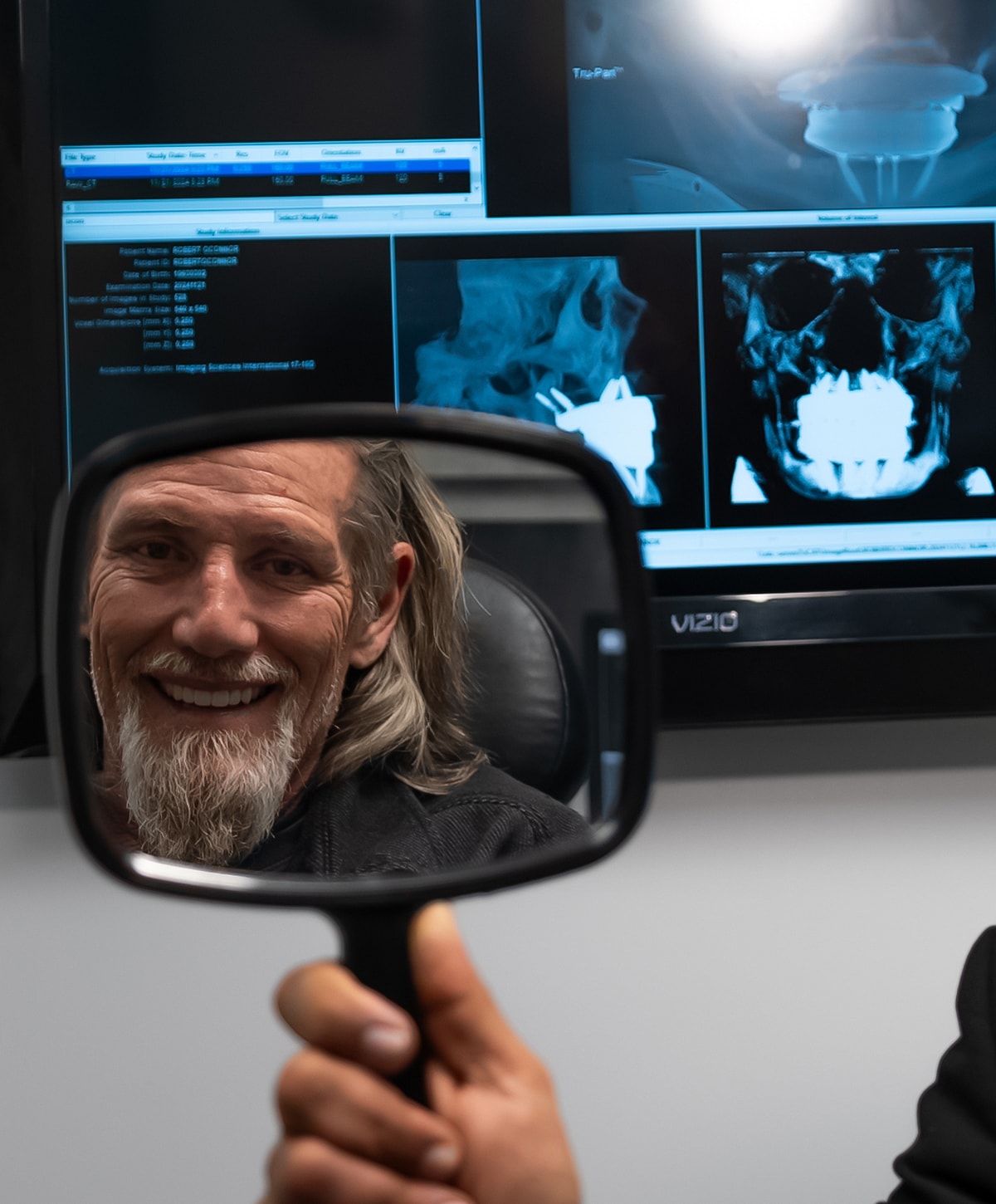
Take the First Step Back to You
If you are dealing with the effects of widespread tooth loss, we can help. Ideal candidates for All-on-4 implant placement typically have significant tooth loss or decay but maintain sufficient jawbone density for implant support. If you've avoided the dentist due to fear or complex dental issues, rest assured. Our compassionate approach might be just what you need. All-on-4 implants offer a durable solution that can revive your confidence and oral health. Whether you're tired of dentures or seeking a permanent fix, these implants provide natural-looking results tailored to your unique needs. Connect with our team of experts at New Teeth Chicago Dental to explore whether this innovative procedure aligns with your goals for a radiant, fully functional smile.
The Care Your Smile Deserves
All-on-4 placement is a major decision, and the experience of your provider matters. At New Teeth Chicago Dental, All-on-4 procedures are a core focus of what we do. Dr. Irfan Atcha has been practicing for more than 30 years and holds Fellow and Diplomate status in respected implant organizations, reflecting deep training and ongoing commitment to implant dentistry.
We help patients who feel nervous or have avoided the dentist for years. From your first phone call, our team takes time to listen, explain each step, and answer questions in clear, simple language. We regularly treat complex implant situations, including patients with significant jawbone deterioration. The focus is on doing it right and standing behind the work until you feel satisfied with how your smile looks and functions. Schedule your consultation to get started today.
The cost of All-on-4 dental implants varies depending on whether you are restoring one arch or both, the type of sedation used, and whether extractions are needed. Because every anatomy is unique, we provide a transparent, all-inclusive fee estimate after your 3D CBCT scan and clinical evaluation. Many patients also utilize third-party healthcare financing to break the investment into manageable monthly payments.
Traditional single implants require substantial vertical bone height, which often forces patients to undergo lengthy bone grafting procedures. The All-on-4 technique specifically overcomes this challenge by tilting the back implants at an angle to engage stronger, available bone in the front of the jaw. Even patients who have worn dentures for years are frequently great candidates without needing a bone graft.
Caring for your permanent bridge is very similar to caring for natural teeth. You will brush twice a day using a soft-bristled toothbrush and non-abrasive toothpaste, and use a water flosser daily to flush food particles from beneath the bridge along the gum line. You should also visit our office every six months for professional cleanings and implant checkups.
The temporary bridge placed on the day of surgery is made from a lightweight, durable acrylic material designed to protect your healing implants while giving you an immediate smile. Your final bridge, placed after osseointegration is complete, is crafted from solid zirconia, a high-strength ceramic material that resists staining, chipping, and wear while mimicking the translucency of natural tooth enamel.
Yes, All-on-4 treatment can be performed on either the upper arch, the lower arch, or both arches simultaneously. During your consultation, Dr. Atcha will evaluate the health of your remaining teeth and discuss the most conservative, effective approach for your specific dental needs.
"A life-changing experience"



