

Published
5 minute read
Dental implants are quickly becoming one of the most popular ways to replace missing teeth. They offer patients the ability to have a new smile that is both aesthetic and functional. When most people hear the term “dental implant” they visualize traditional dental implants, but many people don’t know about mini-dental implants. Mini dental implants are smaller than traditional dental implants and can be used for different purposes. Read on to learn more about what mini-dental implants are, how they work, and what you need to know before getting them.
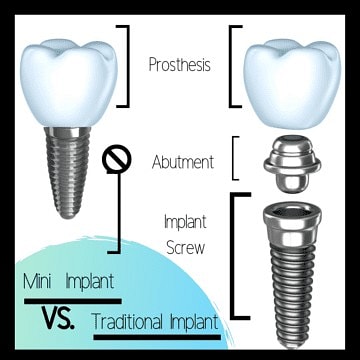
Mini dental implants are smaller than traditional dental implants. In fact, they are usually about half the length of standard size implants and around the diameter of a pencil lead. Due to their smaller size, mini dental implants are also sometimes referred to as narrow diameter implants or small diameter implants. Mini dental implants also have a slightly different structure than traditional dental implants. While a traditional dental implant has separate pieces for the implant screw and abutment, these pieces are fused together in mini dental implants.
Other than the fact that they are shorter in length, narrower in diameter, and have a slightly different structure, mini-dental implants work in a similar way as traditional dental implants. Like traditional dental implants, mini-dental implants are placed into the jawbone, where they will fuse with the surrounding bone.
Because of their small size, mini dental implants are generally used for one of two reasons:
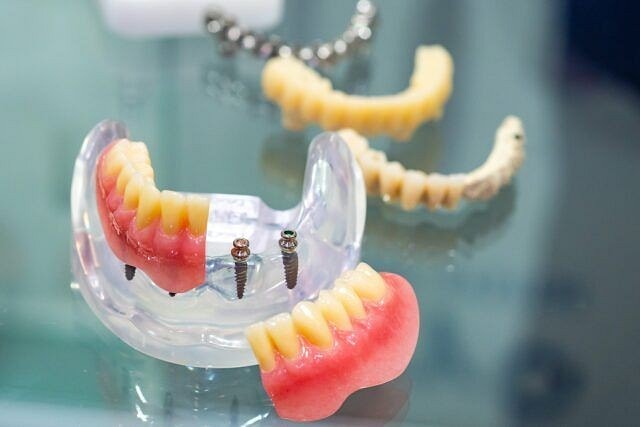
The first, and most common, use for mini dental implants is to stabilize a loose denture. Removable dentures are another common tooth replacement option that is often recommended in cases where dental implants cannot be placed. While upper dentures create a pressurized seal between the palate and denture in order to keep them in place, the lower dentures are far more likely to slip while eating or speaking. The lower jaw is also more likely to suffer bone loss, which can decrease the fit of a lower denture and cause it to slip even more.
In order to prevent a loose lower denture from constantly slipping, mini dental implants can be placed in the lower jaw to stabilize the denture. Although the denture will still be removable, it will be able to snap into place on the implants so that it is secured while eating and speaking. In most cases, mini dental implants can be fitted to an existing denture, unless the denture has become worn down or no longer fits properly.
They can also be used in cases where there is significant bone loss and limited jawbone available. Since standard dental implants are longer and thicker, they require more healthy bone for placement. Mini dental implants, however, do not require as much healthy bone, meaning that they can be used in areas that have already undergone bone loss. With that being said, mini dental implants are generally only used to replace a single tooth that is towards the front of the mouth and has a small tooth root.
One of the most important things that you need to know about mini dental implants is that although they ARE dental implants, mini dental implants do function differently than standard dental implants. At a glance, here some of the pros and cons of mini dental implants to assist you in deciding whether they are right for you:
Mini dental implants are new teeth that replace lost or missing ones. They can be used instead of standard dental implants to prevent the need for a bone grafting procedure, and they can effectively stabilize a loose lower denture with about 4-6 MDIs. For those who have experienced significant bone loss in their jawbone due to trauma or illness, mini dental implants may also be an option because they do not require as much healthy bone like traditional dental implants. The only real negative aspect is that these smaller devices are less durable than larger standard implant models which means you will likely need more replacements over time if you choose this option. If it sounds like mini-dental implants might work well for your needs though, we recommend consulting with your implant dentist to see if it’s the right choice for you.



